By: Laila Schwin and Valery Warner
March 24, 2022
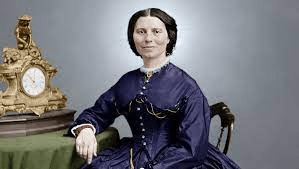
Clarissa Harlowe Barton was an American nurse and the founder of the American Red Cross. She served as a hospital nurse during the Civil War as well as a teacher and a patent clerk. She is well-known for her humanitarian work and for advocating for civil rights.
Barton was born December 25, 1821, in North Oxford, Massachusetts. Her father was Captain Stephen Barton, a member of the local militia. Her mother was Sarah Stone Barton. At the age of three, she and her brother Stephen were sent to school where she learned how to read and write. She also met her only friend there, Nancy Fitt.
At the age of 10, she assigned herself the task of nursing her brother after a fall; she learned how to distribute medicine and how to take care of his body. She continued to care for her brother, and he eventually made a full recovery.
Barton’s parents attempted to make her less timid by sending her to school at Colonel Stones High School. She became depressed, more reclusive, and refused to eat, so her parents brought her back home.
She spent her childhood engaging in what were considered more masculine activities, and she was sent to spend some time with her female cousins to learn social skills and a more feminine way of life.
Barton’s parents went on to convince her to be a school teacher to help her become more social. She received her teaching certificate in 1839 when she was only 17-years-old. She led a campaign to redistrict her school to allow the children of workers to attend the school, too. Barton also demanded equal pay in her teaching job due to the influence that she had in that campaign. Barton went on to teach at various schools for 12 years.
In 1851, Barton’s mother died. Soon after her mom’s passing, she decided to find further education at the Clinton Liberal Institute in New York. She focused on learning languages and writing and was well-revered on campus. In 1852, while teaching again, this time in Hightstown, she was contracted to open a free school in Bordentown, New Jersey. The school later got funding for a rebuild, and upon the completion of the new school, Barton was demoted to an assistant rather than keeping her position as principal. She ended up quitting shortly after.
In 1855, Barton moved to Washington D.C. and started working as a clerk for the U.S. Patent Office. She was the first woman to hold that clerk position within the federal government and was initially being paid the same as her male counterparts. She was later demoted, and in 1858, she was fired because James Buchanan found her “Black Republicanism” unfitting for her role. In 1861, she returned to the patent office as a temporary copyist, the same position she held after being formerly demoted.
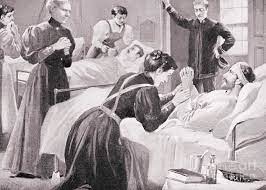
On April 19, 1861, the Baltimore Riot began the combattant history of the Civil War. Barton wanted to serve her country, so she went to the railroad station where the men were being transported; there, she nursed over 40 men. Proving crucial, she provided assistance to the men in uniform and personally took supplies to the building to help the soldiers. Barton, along with several other women, provided clothing, food, and supplies for the sick and wounded soldiers. She learned how to store and distribute medical supplies and offered emotional support to the soldiers by helping them write to their families, talk to the men, and read books to them.
She continued on collecting medical supplies to care for Union soldiers. In August of 1862, Barton received permission to work on the front lines of the war providing medical care to wounded soldiers. She began reaching out and posting ads in newspapers to get medical supplies for the battlefield. During the First Battle of Bull Run, she distributed supplies, cleaned field hospitals, treated and dressed wounds, and served food to the soldiers. Barton provided medical care for both Union and Confederate soldiers. (Yes, you read that correctly.)
Barton was appointed as the “Lady in charge” at the hospitals by serving the Army of the James. She became informally-known as the “Angel of the Battlefield” due to her swift medical services. She served on the front lines providing medical care for the battles of Fairfax Station, Chantilly, Harpers Ferry, South Mountain, Antietam, Fredericksburg, Charleston, Petersburg, and Cold Harbor.
Following the Civil War, Barton gained permission to go forth with “The Search for the Missing Men” in which she responded to inquiries from the families of missing soldiers. She went on to run the Office of Missing Soldiers in Washington D.C. and helped identify and locate more than 22,000 missing men. In 1865, she helped find and properly bury nearly 13,000 people that had died at the Andersonville prison camp where the Confederate army held them as prisoners of war. Over the next four years, she returned more than 20,000 Union soldiers to proper and marked graves.
Barton achieved widespread recognition by delivering lectures around the country about her war experiences in 1865–1868. During this time, she met Susan B. Anthony and began an association with the woman’s suffrage movement, while also becoming a civil rights activist. Baron became mentally and physically tired after her worldwide tours, so her doctor suggested that she move far away from her work. She closed the Missing Soldiers Office in 1868 and traveled to Europe. In 1869, during her trip to Geneva, Switzerland, Barton was introduced to the Red Cross and Dr. Appia. He later would invite her to be the representative for the American branch of the Red Cross and vowed to help her find financial benefactors for the official start of the American Red Cross.
In the beginning of the Franco-Prussian War, in 1870, she assisted the Grand Duchess of Baden in the preparation of military hospitals and gave the Red Cross society much aid during the war. When Barton returned to The United States, she inaugurated a movement to gain recognition for the International Committee of the Red Cross (ICRC) by the United States government. Barton finally succeeded during the administration of President Chester Arthur, using the argument that the new American Red Cross could respond to crises other than war, such as earthquakes, forest fires, and hurricanes.
Barton later became president of the American branch of this community. The first local society was founded August 22, 1881, in Dansville, Livingston County, New York, where she maintained a country home. During the Spanish-American War, this Red Cross aided refugees and prisoners of war.
In 1884, she helped with floods in the Ohio River. In 1887, she provided resources to Texas during a famine. She also assisted workers who were affected by a tornado in Illinois and also treated those affected by Yellow Fever in Florida in 1888. The list of her achievements and the people who she helped is endless.
As criticism arose of her mixing professional and personal resources, Barton was forced to resign as president of the American Red Cross in 1904 at the age of 83 because her leadership style fit poorly into the structure of a charity. She was forced out of office by a new generation of all-male, scientific experts who reflected the realistic efficiency of the Progressive Era rather than her idealistic humanitarianism.
Barton died at her home in Glen Echo, Maryland, on April 12, 1912. Clara Barton had a lasting impact on the medical field and on repatriating missing soldiers. Her work with and establishment of the Red Cross represents an important development that has supported and saved many people.
[Information retrieved from redcross.org & biography.com.]










 THE RETURN OF THE EYE