
By: BHS Features Staff
March 29, 2023
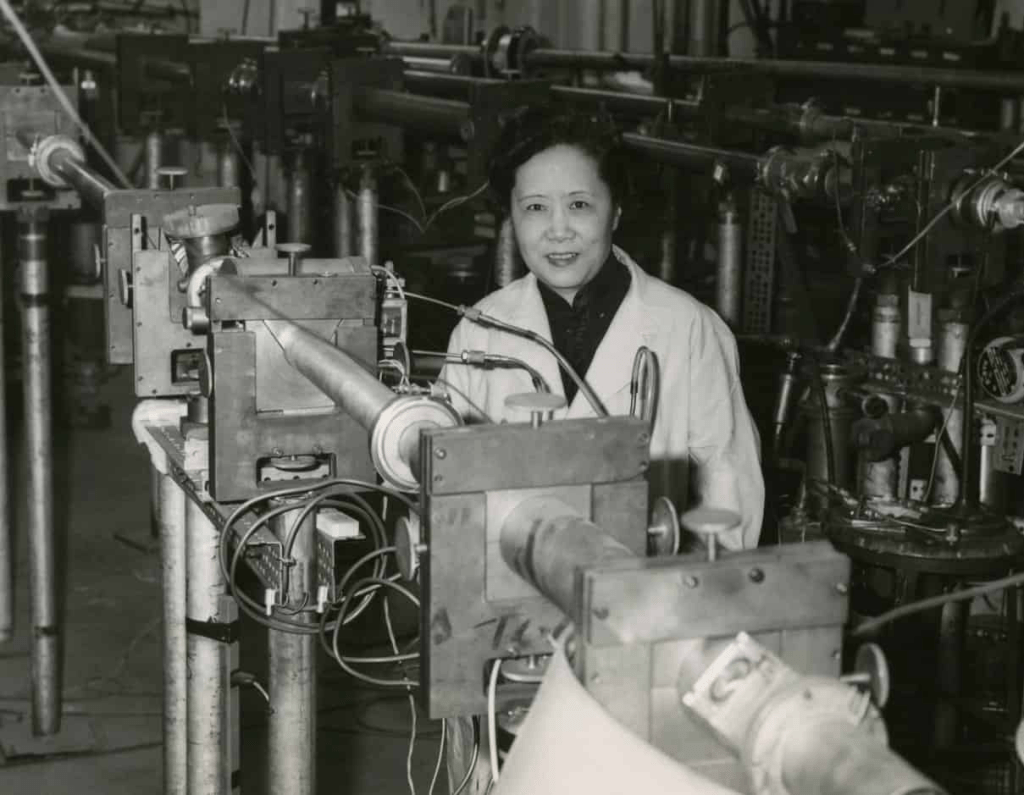
Chien-Shiung Wu was a Chinese American physicist. During the Manhattan Project, she worked at Columbia University, helping to develop the process for separating uranium metal into U-235 and U-238 isotopes by using gaseous diffusion. She also developed improved Geiger counters for measuring nuclear radiation levels. She is believed to have been the only Chinese person and one of the few women working on the Manhattan Project.
Wu was born on May 31, 1912. She grew up near Shanghai, China, in a small city with her mother, Fanhua Fan, who was a teacher, and her father Zhong-Yi Wu, who was an engineer.
During most of her childhood, school was uncommon for women, but this did not stop her from learning. At the age of five, she began going to a school managed by her father who had strong beliefs that girls should earn the same education as boys.
After graduating high school in 1929, Wu went on to college to study Physics. In 1934, she graduated with a degree in Physics from the National Central University in Nanking, China (now known as Nanjing University).
After college, she became a research assistant when her supervisor encouraged her to pursue advanced education in The United States of America. Two years after graduating from NCU, Wu arrived in San Francisco with some financial assistance from her uncle. She enrolled at the University of California, Berkeley, where she completed her Ph.D. in 1940.
In 1942, she married her husband Luke Chia-Lu Yuan, a physicist who she met at UC. They went on to have two children.
Unable to find a research position at a university, Wu became a physics instructor at Princeton University and at Smith College. In 1944, she joined the Manhattan Project at the Substitute Alloy Materials (SAM) Lab at Columbia University, focusing on radiation detectors. Not long after, she was making historical breakthroughs.
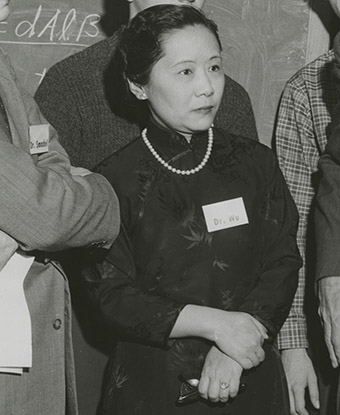
In 1956, she conducted the “Wu experiment,” testing the parity conservation theories of fellow Columbia physicists Tsung-Dao Lee and Chen Ning Yang. Wu’s experiment proved their theories correct and contributed significantly to particle physics and the development of the Standard Model. While it was her experiment that proved the theories to be correct, she was not credited for it, and the following year, physicists Lee and Yang won the Nobel prize.
Her work was not recognized until years later. But, Wu continued to work hard, and by 1966, she received at least seven Nobel nominations and won the inaugural Wolf Prize for her role in her initial discovery.
Not only was Wu one of the first women in STEM but can also an advocate for women. Speaking at a symposium at the Massachusetts Institute of Technology in 1964, Wu said to her audience, “I wonder whether the tiny atoms and nuclei, or the mathematical symbols, or the DNA molecules have any preference for either masculine or feminine treatment.” In addition to speaking out against gender discrimination, Wu also advocated for human rights issues, especially in China.
On February 19, 1997, Wu passed away at the age of 85 in New York City. She lived her whole life following her passion, and she never allowed any challenges to get in the way of her dreams.
Our world will forever be changed because of her.
{Information for this article can be located at nps.gov, womanandtheamericanstory.gov, and atomicheritagefoundation.org.}
 THE RETURN OF THE EYE