
By: Laila Schwin and Valery Warner
March 10, 2022
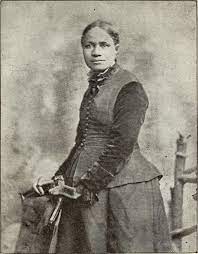
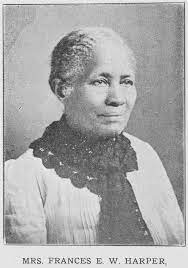
Frances Ellen Watkins Harper was an activist as a suffragist and abolitionist, along with being a poet, teacher, public speaker, and writer. She was one of the first African American women able to get her literature published in The United States of America.
Harper was born on September 24, 1825, in Baltimore, Maryland, which at the time was a slave state. At the age of three, both of her unknown parents died, making her an orphan. She was later adopted and raised by her aunt and uncle who gave her the last name “Watkins”. Harper went to school at the Watkins Academy for Negro Youth, which her uncle had established in 1820. As a civil rights activist and abolitionist, Reverend Watkins had a major influence on his niece’s life and work.
At the age of 13, she worked as a seamstress while also working as a nursemaid for a white family who owned a bookshop. In her spare time, she was able to read the books from the shop and work on her own writings.
In 1850 at the age of 26, Harper moved to Baltimore, Ohio, to teach domestic science at Union Seminary, an AME-affiliated school for Black students near Columbus, Ohio. She worked as the school’s first female teacher. Union Seminary closed in 1863 when the AME Church diverted its funds to purchase Wilberforce University, the first black-owned and operated church. The following year, Watkins took a position at a school in York, Pennsylvania.
In 1839, Harper began her writing career by publishing works in antislavery journals. Her early works were published under her maiden name, Watkins. In 1845, Harper published her first book of poetry titled Forest Leaves or Autumn Leaves; the poetry in this book established Harper as an abolitionist voice. She went on to publish Poems on Miscellaneous Subjects in 1854 which became fairly popular and established her writing career even further.
In 1858, she published one of her now best-known poems, “Bury Me in a Free Land” in an anti-slavery newspaper in Ohio. In 1859, Harper became the first black woman to publish a short story with “The Two Offers” being published in The Anglo-African Newspaper. She continued publishing works there such as her essay “The Greatest Want”. Her essays and poetry focused on the abolition of slavery and the plight of African Americans in the U.S. Throughout her life, Harper published 80 poems, many of which continued on these themes of slavery and freedom.
In 1872, Harper published Sketches of Southern Life, which highlighted the experiences of recently freed slaves in the South and the oppression of black women, even outside of slavery. Between 1868 and 1888, Harper published three novels in a magazine, Minnie’s Sacrifice, Sowing and Reaping, and Trial and Triumph. She is more well-known for her novel Iola Leroy or Shadows Uplifted. This novel was published in 1892 and was one of the first novels to ever be published by a black woman in the U.S. All of Harper’s works (specifically this novel) focus on the social issues of both African Americans and women and the intersection of these two identities.
Harper was a strong supporter of abolitionism, prohibition, and women’s suffrage, progressive causes that were connected before and after the American Civil War. She was also active in the Unitarian Church, which supported abolitionism. In 1853, Harper joined the American Anti-Slavery Society and became a traveling lecturer for the group. During this time, she delivered many speeches and faced much prejudice and discrimination along the way.
A year later, she delivered her first anti-slavery speech called “The Elevation and Education of our People”. After the Civil War ended in 1865, Harper moved South to teach newly-freed Black people during the Reconstruction Era. During this time, she also gave many large public speeches. In 1870, Harper worked with the Freedmen’s Bureau encouraging many freed men in Mobile, Alabama, to “get land, everyone that can” so they could vote and act independently once Congress passed the Fifteenth Amendment.
Harper’s public activism also continued in her later years. In 1891, Harper delivered a speech to the National Council of Women of America in Washington D.C., demanding justice and equal protection by the law for the African-American people.
A lot of Harper’s activism was displayed through speeches that she delivered. She spoke to the National Woman’s Rights Convention in 1866 and encouraged them to form the American Equal Rights Association (AERA). Harper was on the Finance Committee of the AERA and advocated for suffrage for all women, not just white women, as was previously specified by many suffrage groups at the time. AERA divided into two groups upon the introduction of the 15th amendment giving black men the right to vote. It became the National Woman Suffrage Association (NWSA), which did not support the Fifteenth Amendment because it did not also allow women to vote. The other group was the American Woman Suffrage Association (AWSA), which supported the amendment. Harper was one of the founding members of the AWSA as a supporter of the amendment.
Harper would later go on to help develop the National Association for Colored Women (NACW) in 1896. It was primarily founded to avoid the racism of white feminists when advocating for suffrage. In 1897, Harper became vice president of the NACW.
On February 22, 1911, at the age of 85, Frances Harper passed away of heart failure. Her legacy as a writer, a poet, a suffragist, and an abolitionist all live on through her literature and the importance of equal rights for all women.
{Information retrieved from Womenshistory.org}
 THE RETURN OF THE EYE